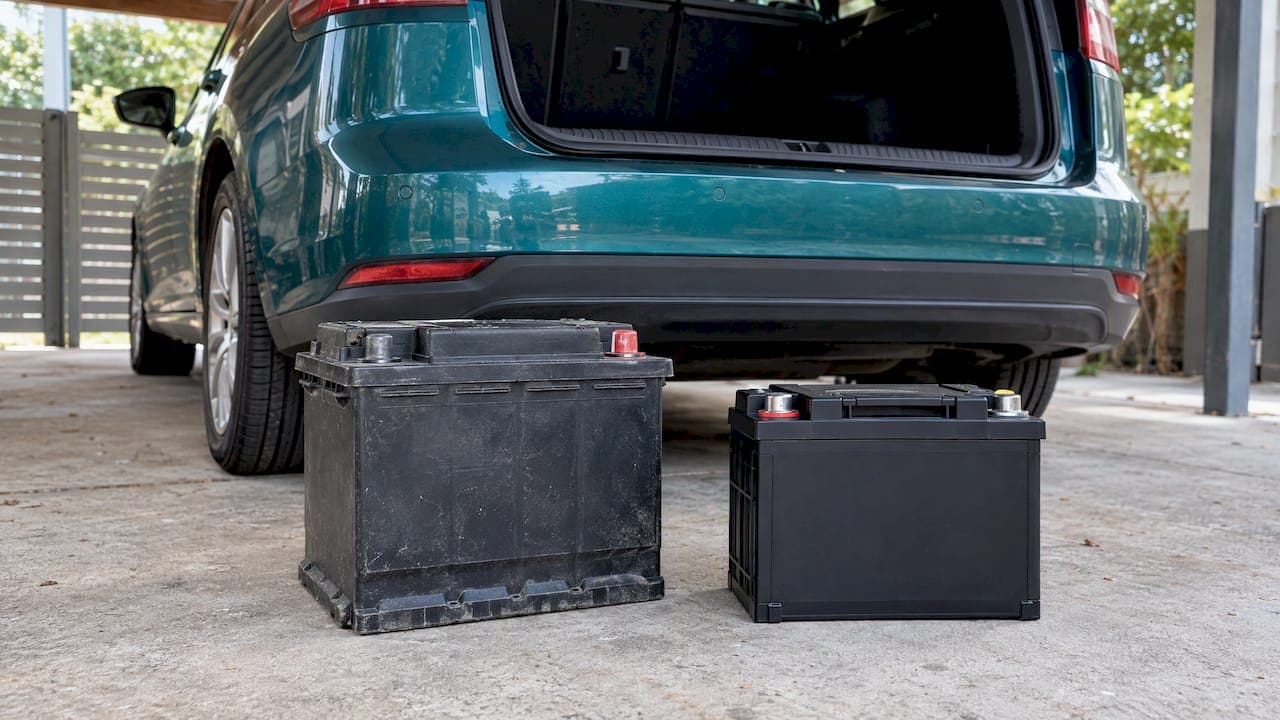
For most Australian cars, a lead acid battery (flooded or AGM) is still the right buy. A lithium (LiFePO4) battery wins when weight, deep cycling or fast charging matter more than upfront price: track cars, tourers with dual-battery setups, and some performance builds. Lithium costs more, needs a compatible charging system and suits some mounting spots better than others. Lead acid is cheaper, proven and almost entirely recycled here.
Below we compare the two on the things that decide a real purchase: price over time, weight, cold and heat, charging, safety, disposal and fitting. Then we give you a simple way to decide.
TL;DR
- Lead acid (flooded or AGM) is cheaper to buy and is what most cars were designed around. If your car has start-stop, AGM is the safe default.
- Lithium (LiFePO4) is much lighter and lasts for far more charge cycles, but costs more upfront and can be a poor fit for a hot engine bay.
- You cannot treat lithium as a plug-and-play swap. It needs a charger with a LiFePO4 mode, and you can't judge its charge with a basic voltmeter.
- Lead acid has a 99% recycling rate in Australia. Lithium recycling is far less mature, so plan its disposal through a proper drop-off.
- Lithium only pays for itself if you use the battery hard or value the weight saving. A daily commuter rarely does.
Table of Contents
- The two chemistries in plain terms
- Lithium vs lead acid at a glance
- Cost: the sticker price is not the whole story
- Weight: where lithium clearly wins
- Cold weather, heat and where you mount it
- Charging and the alternator: the part people skip
- Reading the charge: voltmeters stop being reliable
- Safety and disposal
- Which one for your car?
- Our perspective
- Plan the swap before you spend
- FAQ
- Sources
The two chemistries in plain terms
Lead acid is the old standard. A flooded lead acid battery uses liquid electrolyte and has been the default for decades in standard and older vehicles, as AAA's guide to car battery types explains. AGM (absorbent glass mat) is a sealed lead acid design that copes better with the heavy electrical loads and repeated cycling of modern cars.
Lithium in this context almost always means lithium iron phosphate, written LiFePO4 or LFP. It is a different chemistry again, with a built-in battery management system (BMS) that protects the cells from over-charge, over-discharge and overheating. That BMS is the reason lithium behaves so differently when you charge it and when you try to read its charge.
The lithium-ion batteries in phones and many electric cars are related but not identical. When people ask about lithium vs lead acid for a petrol or diesel car, they mean LiFePO4.
Lithium vs lead acid at a glance
| Factor | Lead acid (flooded / AGM) | Lithium (LiFePO4) |
|---|---|---|
| Upfront price | Lower | Higher |
| Cycle life | Shorter | Much longer |
| Weight | Heavy | Much lighter |
| Charge voltage behaviour | Predictable drop as it discharges | Stays flat until nearly empty |
| Charger needed | Standard lead acid charger | LiFePO4 profile only |
| Hot engine bay | Tolerates it better | Can lose life or cut out |
| Recycling in Australia | Mature, 99% recycled | Immature, low rate |
| Best for | Daily drivers, start-stop cars | Track cars, weight-sensitive builds, heavy cycling |
The sections below put numbers and sources behind each row.
Cost: the sticker price is not the whole story
Lead acid wins on the sticker price, and it isn't close. Lithium wins only when you count how many batteries you will buy over the years.
A 2026 comparative review of lead acid and lithium-ion batteries reports 1,000 to 6,000 cycles for lithium-ion against 300 to 500 for lead acid. Those figures come from an electric mobility context, so treat them as the chemistry's potential rather than a promise for a starter battery. The same review notes lead acid remains the cost-effective incumbent in many segments because of its lower upfront price.

The practical conclusion in that review is total cost of ownership. Lead acid may be replaced several times before one lithium battery reaches the end of its life, so for high-use or critical applications lithium can be cheaper in the long run.
Here is the catch for a normal car. A starter battery does a short, sharp job: it fires the engine, then the alternator tops it back up. It rarely sees the deep cycles that wear out lead acid fast. A daily driver's battery usually dies from age, heat and short trips, not from running through thousands of cycles. So the long cycle life that makes lithium cost-effective in a solar or caravan setup often goes unused in a family sedan.
A worked way to compare
Use your own quotes, not ours, and run this:
- Note the price of a quality AGM battery that suits your car, and the price of a LiFePO4 battery in the same size and cranking rating.
- Estimate how many years you will keep the car. If it is under five years, the lead acid is hard to beat.
- Add the cost of a LiFePO4-compatible charger if you don't own one. Bosch lists a lithium-specific battery charger with a LiFePO4 mode, which shows the kind of equipment involved.
- Add any extra for mounting hardware, a heat shield or a relocation kit if you plan to move the battery out of the engine bay.
- Divide the total by the years you expect to keep it.
If lithium still comes out ahead, or you want the weight saving regardless, it is worth buying. If it doesn't, buy the lead acid and keep the difference.
Weight: where lithium clearly wins
This is lithium's strongest argument. Lead acid has a lower energy density than lithium-ion, so for the same capacity the lead acid battery is much bigger and heavier. For a street car, saving a few kilos in the nose changes very little. For a track car, a lightweight build or a vehicle where the battery sits at one end and affects balance, it is a real gain.
The same logic applies to caravans, camper trailers and boats, where a smaller, lighter battery means more payload. That is the main reason lithium has taken off in the touring world.
Cold weather, heat and where you mount it
Cold
The 2026 review above reports lithium-ion retaining about 85% of its capacity at minus 20°C against about 30% for lead acid. That is a big gap on paper, but most Australian drivers never see those temperatures. In the alpine areas of Victoria, NSW and Tasmania it can matter. Check the manufacturer's own cold-start rating for the specific battery rather than relying on chemistry alone, because some lithium batteries have charging limits in freezing conditions.
Heat
Heat is the bigger Australian issue. Lithium is often sold as a drop-in replacement, but standard LiFePO4 batteries may have operating limits somewhere around 45°C to 65°C. One Australian supplier's technical document on its lithium packs gives a feel for the sealed-pack design and warranty terms, and the general point stands: a hot engine bay on a 40-degree day can push past what a lithium battery likes. That can shorten its life or trigger a safety cut-out.
This is why lithium suits boot-mounted or relocated setups better than an original engine bay position. If the factory location is next to the exhaust manifold or turbo, think carefully before you spend.
Charging and the alternator: the part people skip
A modern car's charging system was tuned for lead acid. Lithium wants a different charging profile, and the BMS inside it is what keeps it safe.
Two things matter.
Your garage charger. A lead acid charger with a desulfation or equalisation mode can send voltages that damage a lithium battery's BMS or push it toward thermal runaway. Only use a charger with a specific LiFePO4 profile, or a smart charger that clearly lists LiFePO4 compatibility. The Bosch document linked above describes exactly that kind of charger.
The quality of the charger. A CSIRO and ACCC report on lithium-ion batteries points to improper charging as the main consumer risk. It advises using manufacturer-approved chargers, because cheap generic ones often can't communicate with the BMS needed to charge safely.
Your car's own alternator and voltage regulation matter too. Some modern cars use smart charging that varies voltage and, on start-stop cars, expects an AGM battery. AAA's guide calls AGM the standard for vehicles with start-stop, and LiFePO4 better for weight-sensitive uses, with a need for a compatible charging system. If your car has start-stop or a battery sensor on the negative terminal, check with the battery maker that their lithium battery is approved for that system before buying.

Reading the charge: voltmeters stop being reliable
With lead acid, you can put a multimeter on the terminals and get a decent idea of how charged it is, because the voltage falls steadily as it empties. Lithium doesn't play that way.
The US Department of Energy's Alternative Fuels Data Center covers the lithium iron phosphate chemistry's stable plateau voltage. Practically, a 12V LiFePO4 battery has a nominal voltage around 13.2V (four cells at about 3.3V each) and holds a flat voltage across most of its range. A voltmeter can read healthy until the battery is almost empty.
One manufacturer's users manual for a starting battery is built around the idea that the lithium battery is a maintenance-free replacement for a 12 volt lead acid unit. Even so, you need the BMS or a monitoring app to know the real state of charge. If a car sits for weeks, as many weekend cars do, check how the battery's BMS handles self-discharge and low-voltage cut-off. A BMS that shuts off protects the cells but can leave you with a car that won't start until you reset it.
Safety and disposal
Both batteries are safe when used properly, and both can hurt you when they aren't. Lead acid contains acid and gives off hydrogen when charging, so ventilate and keep sparks away. Lithium's risk is fire if it's damaged, overheated or charged wrongly, which is why the charger advice above matters.
Disposal is where the two differ most in Australia. The Department of Industry, Science and Resources describes a mature closed-loop recycling system for lead acid batteries, with a 99% recycling rate. Lithium-ion recycling faces cost hurdles and a lack of local processing capacity. The 2026 review above puts the figure at roughly 10%.
Practically:
- Old lead acid batteries are accepted by most battery retailers, mechanics and council waste centres. Hand yours in when you buy a new one.
- Lithium batteries must never go in the household bin because of fire risk. Use a local council waste centre or a scheme such as B-cycle, which lists drop-off points.
- Check where you will take a lithium battery before you buy it, not after it dies.
Which one for your car?
Stay with lead acid (flooded or AGM) if:
- You drive a daily commuter or family car.
- Your car has start-stop. Fit AGM, as AAA's guide recommends.
- The battery sits in a hot engine bay.
- You want the lowest cost per year over a typical ownership period.
- You don't want to buy a new charger or learn a monitoring app.
Consider lithium (LiFePO4) if:
- You run a track, drift or lightweight build and every kilo counts.
- You can mount the battery in the boot or another cool place.
- You regularly deep-cycle the battery, for example with accessories, a fridge or a winch in a touring vehicle.
- You are happy to buy a LiFePO4-compatible charger and monitor the battery.
- You keep the vehicle long enough to spread the cost.
And what about AGM versus lithium specifically?
AGM is the mid-tier lead acid option: more expensive than flooded, cheaper than lithium, sealed, and a good match for modern electrics. Lithium beats it on weight and cycle life, and AGM beats it on price, heat tolerance and simple compatibility. If your car requires AGM and lives in a hot bay, AGM is the safer pick. If you are building a lighter car and know what you're doing with charging, lithium is the upgrade.
Our perspective
We built DIYPro because people kept getting the same job wrong: they bought the wrong part, or paid too much for it, or never knew what a fair price was. Batteries are a good example. The marketing for lithium makes it sound like a straight upgrade, and for some owners it is. For most, the honest answer is that the cheapest sensible battery is a good AGM or flooded battery that matches what the car was designed for.
Our advice is to buy for the job in front of you. If you only change the battery once every four or five years, the long cycle life of lithium is something you pay for and rarely use. If you want the weight saving or you cycle the battery hard, lithium makes sense, but price the charger and mounting into the decision, not only the battery.
The other thing a battery swap teaches is how much of a repair bill is parts, tools and labour. Fitting a battery is one of the easier jobs for a beginner, with the right gloves, eye protection and the terminals disconnected in the right order. Seeing the numbers side by side is what lets you decide whether to do it yourself or hand it over.
— Ryan
Plan the swap before you spend
DIYPro is a platform for Australian car owners that puts the full DIY cost of a job next to a typical workshop quote, with matched parts, the tools you need and tutorials that fit your skill level. You tell it what is wrong with your car or what you want to do, then choose a premium, value or budget tier. On the sort of job we show, owners can keep around $949 by going DIY instead of a typical $1,701 workshop quote, though every job and car is different. We are currently building the waitlist, so you can join the DIYPro waitlist to be first in when it opens.
If you like comparing options before you buy, our guide on copper vs iridium spark plugs uses the same approach: what the cheaper and dearer parts actually give you.
FAQ
Are lithium car batteries worth it?
For most daily drivers, no. The higher price buys long cycle life and low weight, and a normal starter battery uses little of either. They make sense for track cars, touring setups and builds where weight or heavy cycling matters, and where the battery can sit away from engine heat.
Can I replace a lead acid car battery with lithium?
Often yes, but it isn't a simple swap. You need a battery rated for your car's cranking needs, a charger with a LiFePO4 profile, and a check that the battery works with your car's charging system. Cars with start-stop or battery sensors need particular care, so confirm approval with the battery maker.
Is a lithium battery better than AGM?
It depends on the job. Lithium is lighter and lasts for more cycles, while AGM is cheaper, tolerates heat better and is the standard choice for start-stop cars. If your car requires AGM, stay with AGM unless the maker approves a lithium option.
What are the disadvantages of a lithium battery?
The main ones are a higher upfront cost, the need for a lithium-compatible charger, a flat voltage that makes a basic voltmeter unreliable, and limits in very hot or freezing conditions. Recycling is also less developed in Australia than for lead acid, so you need a proper drop-off point.
How do I dispose of an old car battery in Australia?
Take lead acid batteries to a battery retailer, mechanic or council waste centre, where they feed a recycling system with a 99% recovery rate. Lithium batteries must never go in a household bin. Use a council facility or a scheme such as B-cycle.
Sources
- Lead-acid and lithium-ion batteries for electric mobility applications: a comparative review (2026)
- Car Battery Types: Which One Is Best for Your Vehicle? (AAA Automotive)
- Alternative Fuels Data Center: Batteries for Electric Vehicles
- Priority 4: Sustainability, ESG and circular economy (Department of Industry, Science and Resources)
- CSIRO and ACCC report on lithium-ion batteries
- Bosch C-line Battery Charger C80-Li specifications
- Amptron lithium battery technical document
- EarthX Performance Starting and Charging Users Manual