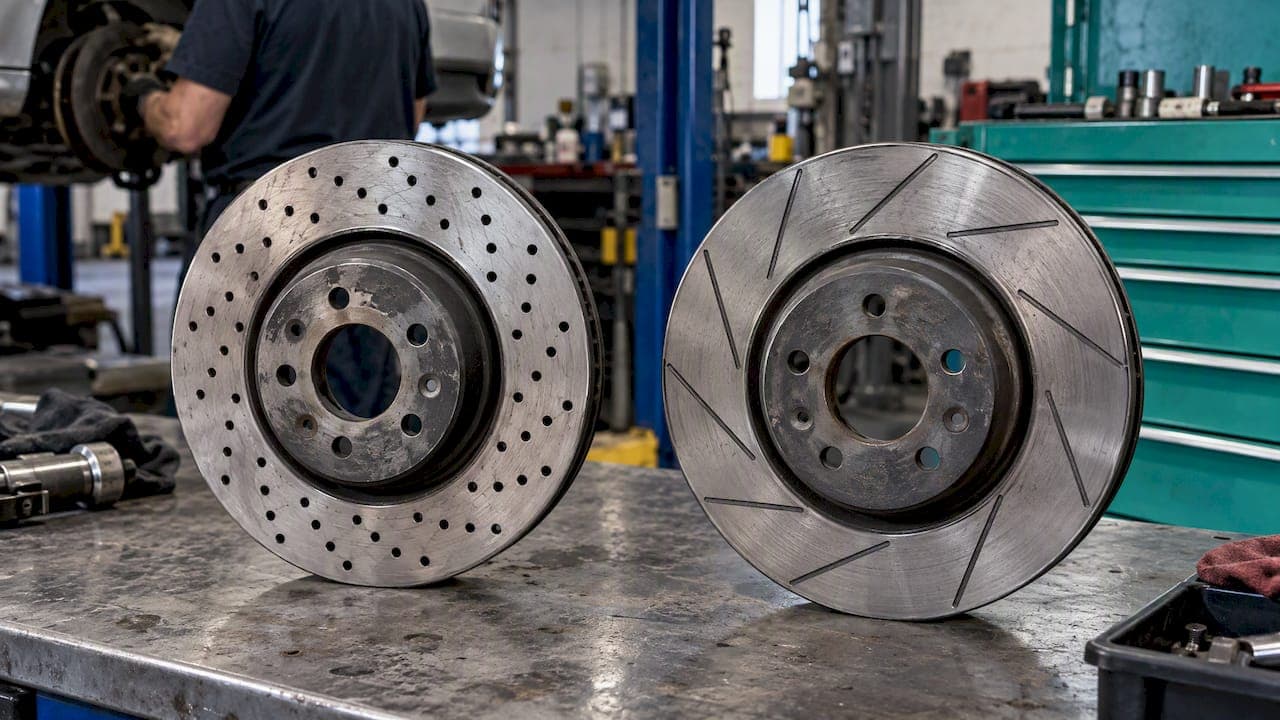
For most Australian drivers, neither. Standard vented rotors handle normal commuting and weekend driving well. Slotted rotors make sense if you tow, drive hard down mountain roads or do track days, because they keep their strength and keep the pad surface fresh. Drilled rotors shed water and heat well on the street, but the holes can crack under sustained extreme heat. If you want the look and a modest bite upgrade, a quality drilled and slotted set from a reputable maker is a fair middle path. This guide explains why, what they cost, and how to fit them properly if you're doing the job yourself.
TL;DR
- Slotted rotors suit towing, heavy loads and track use. They resist cracking better and clear glaze off the pads, but can wear pads 10 to 20% faster than smooth rotors.
- Drilled rotors vent heat and water well for daily and wet driving, but cheap, generic ones are prone to cracking under hard, sustained use.
- For roughly nine in ten street-driven cars, standard vented or solid rotors are enough. Upgrade for a real need, not a hoped-for gain.
- Rotor resurfacing is rarely worth it now. Replacement is the standard advice for most DIYers and workshops.
- Fitting matters as much as the rotor: clean off the factory coating, torque the wheel nuts in a star pattern and skip the impact gun.
Table of Contents
- What drilled and slotted rotors actually do
- Slotted vs drilled: side-by-side
- Why drilled rotors crack, and how to avoid it
- Slotted rotors: the benefits and the catches
- Do you actually need either?
- What they cost in Australia
- Resurface or replace?
- Fitting rotors yourself: the steps people get wrong
- Our perspective: look at the whole job, not just the rotor
- Plan your brake job before you buy
- FAQ
- Sources
What drilled and slotted rotors actually do
A brake rotor turns your pad's friction into heat. Two side effects matter when you brake hard: the pad and rotor create gas and dust at the contact surface, and the rotor soaks up a lot of heat. Drilling and slotting are two different ways of dealing with those problems.
Drilled rotors have a pattern of holes through the face. According to AutoGuru, the holes are there to dissipate the gases produced by repeated hard stops. They also give water somewhere to go, which is why drilled rotors do well in wet conditions.
Slotted rotors have shallow grooves cut across the face instead. The slots sweep gas, dust and water out from under the pad and keep the pad surface refreshed, which helps prevent glazing. Because there are no holes through the metal, there are fewer places for cracks to start.

Drilled and slotted rotors combine both. These are the popular aftermarket kits you see advertised as a bolt-on upgrade. They look the part, and a well-made set does add some venting and bite, but they carry the drawbacks of both designs if the quality is poor.
One point from a major brake manufacturer is worth knowing. Cross-drilling started out as a way to clear gas and water from between the pad and the disc. Modern pad materials produce far less gas than the old ones, so the original reason for the holes matters less than it used to. Today the holes are as much about cooling, water and appearance as gas.
Slotted vs drilled: side-by-side
| Factor | Slotted | Drilled | Drilled and slotted |
|---|---|---|---|
| Wet-weather performance | Good, slots clear water | Very good, holes vent water | Very good |
| Heat handling | Good | Good, but can crack under extreme sustained heat | Good if well made |
| Crack risk | Low | Higher, especially on cheap rotors | Moderate to high on cheap rotors |
| Pad wear | Can be 10 to 20% higher than smooth rotors | Closer to standard | Usually higher than standard |
| Pedal feel and bite | Consistent | Good | Strong initial bite |
| Best for | Towing, heavy loads, track | Wet daily driving, looks | Street upgrade, looks |
| Noise | Light clicking or whirring is normal | Usually quiet | Light clicking is normal |
The heat and crack points come from AutoGuru's guide to rotor types, which says drilled rotors do well in daily and wet driving but can crack under extreme, sustained thermal stress such as racing or heavy towing. It names slotted rotors as the preferred choice for those heavy-duty jobs.
Why drilled rotors crack, and how to avoid it
A hole in a metal disc is a stress concentrator. Heat the rotor hard, cool it quickly, and small cracks can start at the edges of the holes and spread. That's the core trade-off with drilled designs.
Quality matters a lot here. Brembo explains that good drilled rotors are engineered with specific hole density, shape and distance from the edge and the cooling vanes, to limit crack propagation. Cheap, generic drilled rotors often lack those stress-relief features and can fail early.
Manufacturing treatment helps too. A study in the International Journal of Automotive Technology found that specific heat treatments can cut crack propagation rates by up to 51.3% in drilled rotors. In practice that means looking for chamfered holes and stress-relieved castings rather than just the lowest price.
What to check before buying drilled rotors:
- Chamfered (bevelled) hole edges rather than sharp ones
- A known maker with fitment data for your exact vehicle
- A rotor rated for your use, not just a look-alike
- Whether pads are included, since this changes the price a lot
If you tow a caravan or boat regularly, crack risk is the main reason to lean towards slotted rather than drilled.
Slotted rotors: the benefits and the catches
Slotted rotors are the safer performance upgrade. The benefits are real but specific:
- Pad cleaning. The slots wipe the pad face, which helps prevent glazing and keeps pedal feel consistent.
- Water clearing. Useful in heavy rain and when crossing creeks or washouts.
- Structural strength. With no through-holes, the rotor holds up better in towing and track conditions.
The catches are just as clear. You can expect faster pad wear, up to 10 to 20% more than with smooth rotors according to AutoGuru. That cost adds up over a few pad changes. You may also hear a light clicking or whirring when braking. That's usually just gas and air escaping through the slots and not a sign of a mechanical fault. If you hear grinding, a pulsing pedal or a steady scrape, that's different, and you should have a mechanic look at it.
Do you actually need either?
Probably not. The expert view reported by AutoGuru is that for about 90% of street-driven vehicles, standard vented or solid rotors are fully capable of normal driving. Upgrading should come from a specific need, such as frequent towing, living in hilly or mountainous country, or track use, not from an expectation of big gains for the school run.
Use this quick guide:
- Commuting, mostly city and highway: standard vented rotors with good pads. Spend the saving on quality pads and fluid.
- Wet climate or lots of rain: a quality drilled or drilled and slotted set is reasonable, as long as it comes from a reputable maker.
- Towing, loaded 4WD, long descents: slotted rotors, and pads matched to the job.
- Track days: slotted, with track-appropriate pads and a plan for inspecting them often.
- You just like the look: go ahead, but buy quality and accept the pad-wear trade-off.
When you fit a different rotor type, the pads should be chosen to suit. A mismatch can cancel out any benefit. If you're unsure, ask whoever sells you the parts to confirm fitment for your exact make, model and year.
What they cost in Australia
Prices vary widely by vehicle, brand and what's in the box. As of 2026, premium two-piece performance rotors from a major brake maker can cost more than $2,100 per pair, with one listing at $2,172. Direct-replacement drilled and slotted sets from a performance brand typically run from about $136 to $472 per pair depending on the model and whether pads are included.
Two things to keep in mind when you compare prices:
- A listing that shows a very low price may be for a single rotor, or may exclude pads. Check the title carefully.
- Some OE-replacement rotors are made to match what your car came with. If your vehicle left the factory with solid rotors, the replacement will be solid, and if it came with slotted rotors, the replacement will be slotted. Fitment details are on the product page, so read them.
Then add the rest of the job: pads, brake cleaner, a torque wrench if you don't own one, and brake fluid if it's due. That's why the line items matter more than the sticker price on one part.
Resurface or replace?
The old advice was to "turn" rotors on a lathe at each pad change. Few workshops do that now. Tire Review reports that rotor turning has largely died down because labour costs often outweigh the benefit, and because precision is hard to achieve with modern hat-style rotors. Limited training or poor lathe adapters can leave you with vibration or incorrect mounting. Replacement is the standard recommendation for most DIYers and professional shops.
It isn't impossible. It's technically possible to machine rotors, including drilled and slotted ones, but it needs the right equipment, a rotor with enough thickness left, and someone who knows what they're doing. For most cars, the cost of a new pair is close to the cost of machining, and new rotors give you a fresh minimum-thickness margin.
Replace when:
- The rotor is at or near its minimum thickness (stamped on the rotor or listed in the service data)
- You can see cracks, particularly around holes on drilled rotors
- There's deep scoring, heavy rust or a blue heat-stained surface
- You have a persistent pulsing pedal after fitting good pads
If you're not sure, measure the rotor with a micrometer or let a workshop do it. This isn't a spot for guessing: brake parts are safety-critical, and an inspection by a licensed mechanic is cheap compared with a failure.
Fitting rotors yourself: the steps people get wrong
Swapping rotors is a manageable job for a careful DIYer with the right tools. Most of the problems people have after a rotor change come from three avoidable mistakes.
Clean the new rotors properly
New rotors come with a rust-preventative coating. If it isn't removed, it can contaminate your new pads straight away, reducing braking performance and possibly ruining the set. Wipe the friction and mounting faces with brake cleaner on a cloth. Rotor makers' fitment guides, such as this Australian rotor fitment guide, warn you not to wipe or spray the painted hat area or the painted outside edge.

Tighten wheel nuts the right way
Use a torque wrench and tighten in a star or criss-cross pattern. Rattling nuts on with an impact gun applies uneven clamping pressure to the rotor hat and is a primary cause of runout, which shows up as vibration. Use the torque figure from your owner's manual or service data, and re-check after the first short drive.
Match the parts
New rotors and new pads should go together. Fitting fresh pads on worn rotors, or the reverse, usually gives uneven wear and noise. Check the rotor's direction too: some drilled and slotted rotors are handed, meaning left and right are different, so check the markings before you fit them.
After the job, follow the bedding-in procedure from the pad maker. It's usually a series of moderate stops that heat the pads and rotors gradually. Don't skip it, and keep the first drive gentle.
Our perspective: look at the whole job, not just the rotor
We come at this from the workshop floor. Our founder has more than 25 years as a mechanic, and the same questions come up again and again with brakes.
First, people spend a lot of time choosing between drilled and slotted and not enough on pads, fluid and fitting. A great rotor with the wrong pad, or a perfect set fitted with an impact gun and no brake cleaner, will feel worse than a plain set done properly.
Second, the honest answer for most cars is the boring one. If you drive in town and on the highway, quality standard rotors are the right buy. If you tow or drive hard, slotted is the sensible upgrade. Drilled is mostly a call about wet-weather use and looks, and it only pays off if the rotor is well made.
Third, the real decision is DIY or workshop, and that depends on the full cost. Parts, tools you don't yet own, time, and a fair quote from a mechanic all sit in different places, so it's hard to compare them. That scattered pricing is exactly why we built our platform. You tell it the job, see the DIY cost against a typical workshop quote line by line, then pick a budget, value or premium tier for the parts. In our own example, the DIY route keeps around $949 compared with a $1,701 workshop quote. Brake work is safety-critical, so if a job is beyond your skill or tools, paying a mechanic is the right call, and having the numbers makes that decision easier either way.
— Ryan
Plan your brake job before you buy
If you're weighing up a rotor swap, put the whole job on one page before you open another tab. Diysavepro is an Australian platform where you describe what you want done, see parts, tools and a workshop quote side by side, choose your budget tier, and follow tutorials matched to your skill level. We're currently building our waitlist, so you can join the waitlist and be among the first to try it.
FAQ
Are drilled rotors better than slotted?
Not across the board. Drilled rotors do well in wet, everyday driving, but they're more prone to cracking under extreme, sustained heat. Slotted rotors are the better choice for towing and track use because they hold up structurally and help prevent pad glazing.
Is it better to resurface or replace rotors?
Replace, in most cases. Labour costs often outweigh the saving, and modern hat-style rotors are hard to machine accurately. Machining is possible if the rotor has enough thickness left, but a new pair is usually the safer and simpler option.
Why are my slotted rotors making a clicking noise?
Light clicking or whirring is common with slotted rotors. It's usually the sound of gas and air escaping through the slots as they pass under the pad. If you hear grinding, scraping or feel a pulsing pedal, have the brakes inspected by a mechanic.
Do slotted rotors wear pads faster?
Yes, usually. Slotted rotors can increase pad wear by about 10 to 20% compared with smooth rotors. That's the price of the cleaning action that keeps the pad surface fresh.
Do I need drilled or slotted rotors for my daily driver?
Probably not. For about 90% of street-driven cars, standard vented or solid rotors are enough. Consider upgrading if you tow often, drive in mountainous areas or do track days.
Sources
- AutoGuru: Brake rotors, solid, vented, drilled or slotted
- Tire Review: How to know whether to resurface or replace brake rotors
- Brembo: Xtra disc design
- International Journal of Automotive Technology: crack propagation in drilled rotors
- AME Motorsport: Drilled vs slotted rotors engineering guide
- Race Technologies: Brembo on cross-drilled rotors
- Automotive Superstore: 2-piece drilled slotted rotor listing
- Autobarn: drilled and slotted rotor pair listing
- Rotor fitment guide (PDF)