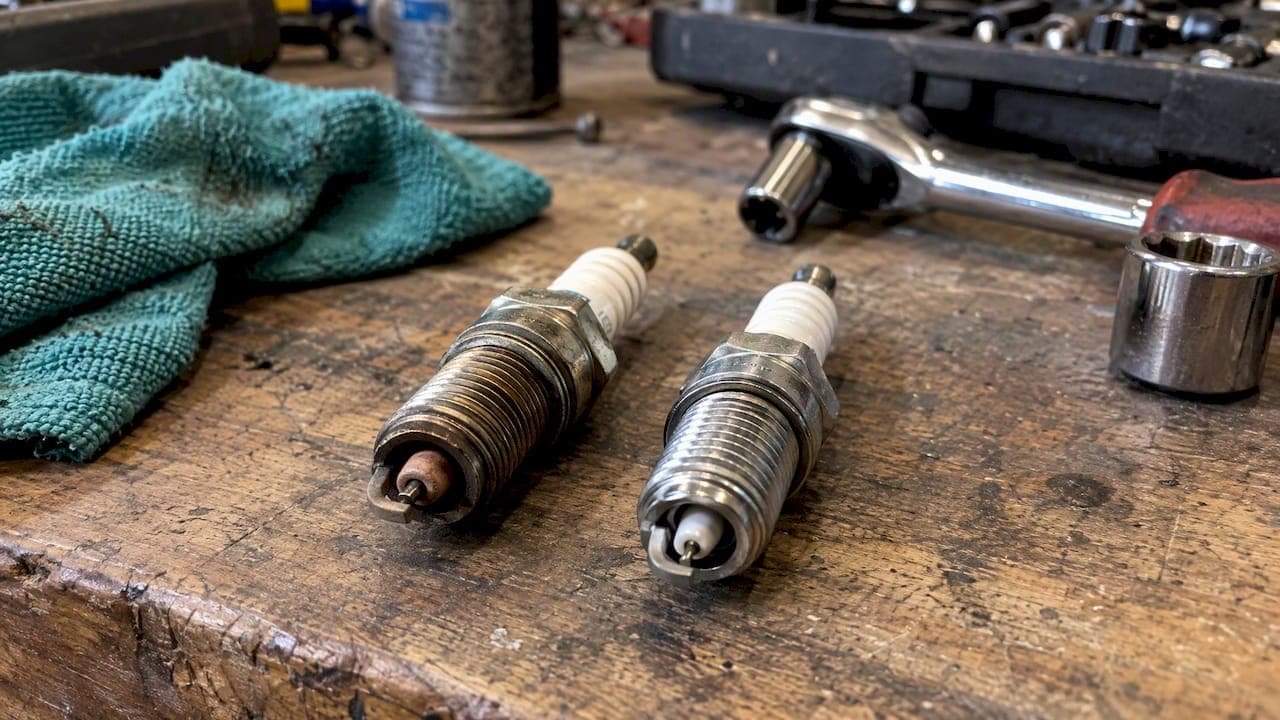
Use whatever your engine was designed for. If your car left the factory with iridium plugs, fit iridium again. If it came with copper, copper is the cheapest correct choice, and iridium is an optional upgrade that mostly buys you a longer service interval. Going the other way, from factory iridium down to copper, is the one swap that tends to cost you money in the end.
That is the short answer. The longer one depends on your ignition system, how long you plan to keep the car and how much you value not doing this job again for years. Here is how to work it out.
TL;DR
- Copper plugs are cheap and conduct well, but wear quickly. AutoZone puts their design life at roughly 20,000 to 30,000 miles (about 32,000 to 48,000 km), against up to 100,000 miles (about 160,000 km) for iridium.
- Iridium costs more per plug, but over the life of the car the gap narrows because you replace them far less often.
- Match the plug to the engine. Upgrading copper to iridium is usually fine. Downgrading factory iridium to copper can hurt performance, emissions and service life.
- Heat range and gap matter more than the metal. The wrong heat range can damage an engine even if the plug physically fits.
- Iridium electrodes are delicate, so gap and fit them carefully.
Table of Contents
- What actually differs between copper and iridium plugs
- Lifespan and cost compared
- Copper vs platinum vs iridium: where platinum fits
- When copper is the right choice
- When iridium earns its price
- Heat range matters more than the metal
- How to choose: a short checklist
- Fitting iridium plugs without wrecking them
- Our perspective
- Plan the whole job, not just the plugs
- FAQ
- Sources
What actually differs between copper and iridium plugs
Every spark plug does the same job: it jumps a spark across a small gap to light the air and fuel mixture. The difference is the material of the centre electrode, the part that takes the punishment.
Copper plugs have a copper core. Copper is an excellent conductor and transfers heat quickly, but it is soft, so the electrode has to be fairly thick and is wrapped in a nickel alloy to give it some durability. A thick electrode wears faster and is less efficient at starting a flame.
Iridium plugs use a much harder metal with a very high melting point. That lets manufacturers machine the centre electrode down to a fine wire. Fine-wire iridium centre electrodes of around 0.5 to 0.6 mm can reduce the voltage the coil needs to produce by up to 20%, which helps in engines with coil-on-plug ignition or high exhaust gas dilution.

Why "copper conducts better" is not the whole story
The forum argument goes like this: copper is the better conductor, so copper must be better. It is true on paper. It is also beside the point.
The real engineering benefit of iridium is hardness. A harder, higher-melting metal allows a smaller, sharper electrode. NGK explains that a cooler, bulkier electrode drains energy from the flame core through heat transfer, called quenching, and in severe cases can extinguish it. A fine tip presents less metal to the flame, so ignition is more reliable. Conductivity of the electrode tip is a minor factor next to that.
Lifespan and cost compared
Here is the practical comparison most owners want.
| Copper | Iridium | |
|---|---|---|
| Typical service life | About 32,000 to 48,000 km | Up to about 160,000 km |
| Electrode | Thick, nickel-coated copper core | Fine wire, very hard metal |
| Price per plug (US figures) | $3 to $8 | $10 to $25 for common applications |
| Wear rate | Faster gap growth | Slow gap growth |
| Best suited to | Engines designed for copper, older designs | Modern engines, coil-on-plug, turbo and high-compression designs |
The life and price figures come from AutoZone's copper versus iridium comparison. Those prices are in US dollars, so treat them as a ratio rather than a shelf price. Australian prices vary by brand, application and retailer, and a plug for a performance or European engine can cost well above the typical range. Check the current price for your exact plug number before you decide.
A worked example: four-cylinder, 10 years of ownership
Take a typical four-cylinder car and use the ratio above. Say copper plugs cost one unit each and iridium cost about three times that. You need four plugs per change.
- Copper at about 40,000 km per change, driving 15,000 km a year: roughly one change every 2.5 years, so about four changes over a decade, or 16 plugs.
- Iridium at about 100,000 km per change, same driving: one change in the first decade, or possibly two, so 4 to 8 plugs.
Sixteen plugs at one unit is 16. Four to eight plugs at three units is 12 to 24. The totals land in the same range, and that is before counting your time. Each change is a job: access, removal, gapping, torque. If your engine buries the plugs under an intake manifold or coil packs, fewer changes is worth real money, especially if you would otherwise pay a workshop for labour.
The numbers swing the other way if the car is old, cheap and you will sell it in two years. Then copper in a copper-spec engine is the sensible spend.
Copper vs platinum vs iridium: where platinum fits
Most readers searching this are really choosing among three metals, so here is where platinum sits.
- Copper: cheapest, shortest life.
- Platinum: a harder electrode than copper, with a higher melting point and greater density. It lasts longer than copper and usually costs less than iridium.
- Iridium: harder than both, longest life, most expensive.
Platinum is a middle step, and it is common as a factory fit on many engines. AutoZone's iridium versus platinum guide is a good read if platinum is on your shortlist. The same rule applies: use what the manufacturer specified, or step up in material within the same plug design and heat range.
Double platinum and waste-spark systems
Some engines fire two cylinders from one coil, called a waste-spark system. One plug sparks on the compression stroke, the other at the same time on the exhaust stroke. NGK notes that wear then differs by polarity: positive-polarity plugs wear more at the ground electrode, while negative-polarity plugs wear faster at the centre electrode. In these systems, a double precious metal plug (iridium centre, platinum ground electrode) is the right tool, because copper wears out its gap very quickly.
If you are unsure whether your car uses waste-spark ignition, look up the ignition layout for your engine code or check your workshop manual before choosing a cheaper plug.
When copper is the right choice
Copper is not a poor plug. It is a plug designed for certain jobs.
- Your engine was built around copper. Many older and simpler engines specify it, and the ignition system is tuned for it.
- You change plugs often anyway. Some highly modified or heavily boosted engines need fresh plugs at short intervals, and enthusiasts sometimes prefer a cheap plug they swap regularly. Follow your tuner's advice, since that usually involves a colder heat range as well.
- You are keeping a low-value car going. If the next owner is not your problem, spending triple per plug may not return anything.
If you are in this group, the useful upgrade is a quality copper plug of the right number, correctly gapped, rather than a random cheap one.
When iridium earns its price
- Your engine came with iridium. Fit like for like. Stay with that specification.
- Coil-on-plug ignition and modern engines. The lower voltage demand and focused spark suit them.
- Hard-to-reach plugs. The longer interval saves repeated labour.
- You plan to keep the car for years. The up-front premium spreads over many more kilometres.
There is a fair counterpoint: iridium is not a magic upgrade. Engineers caution that engines are designed for specific plug materials and heat ranges to hit precise emission, combustion and longevity targets. Moving from copper up to iridium is often acceptable, while moving from factory iridium or platinum down to copper can reduce performance, emissions and plug life. Do not expect big power gains from swapping like-for-like specifications. The honest benefit of an upgrade is longevity and consistency, not extra horsepower.
Heat range matters more than the metal
If you remember one technical point, make it this one. Heat range is not how hot the spark is. NGK defines it as the plug's ability to dissipate heat from the combustion chamber into the cylinder head. A plug that is too hot for the engine can overheat and cause pre-ignition. A plug that is too cold can foul with carbon.
That is why a plug that screws in and looks right can still be wrong. Match the plug code, not just the thread and reach, and never choose on the basis that iridium "burns hotter" or copper "runs cooler". Heat range is built into the number on the plug.
How to choose: a short checklist
- Find the factory specification. Check your owner's manual, the engine bay label or a parts catalogue for the exact plug code.
- Note the ignition type. Coil-on-plug, distributor or waste-spark each have preferences.
- Decide how long you will keep the car. Under two or three years in a copper-spec engine, copper is fine. Longer, price the iridium over the full interval.
- Check the modifications. Turbo, supercharger or tune? Ask your tuner for the heat range they want.
- Compare the total cost. Plugs, any gasket or seal parts, and your time or the workshop's labour.
If you want budget versus premium, think in tiers. A budget tier is the correct-spec copper plug. A value tier is a platinum or entry iridium plug in the right code. A premium tier is the manufacturer's own long-life iridium. Whatever the tier, the code has to match.
Fitting iridium plugs without wrecking them
Iridium centre electrodes are fine and fragile. A few rules help:
- Gap carefully. Precious metal plugs can be damaged by improper gapping. Never use a tool that pries against the centre electrode, and do not clean them with abrasives. Many are pre-gapped, so check before adjusting at all.
- Know why the gap matters. The gap sets the voltage at which the spark arcs, so a wrong gap affects ignition and performance.
- Torque to specification. Cross-threading in an aluminium head is an expensive mistake. Use the manufacturer's torque figure.
- Skip the anti-seize. Many modern plugs come with plating that removes the need for it, according to NGK's guidance, so check the plug's instructions before adding any.
- Keep the plugs in order, cylinder by cylinder. Both electrodes wear and deposits build up over time, and reading the old plugs can tell you about the engine's condition.
Our perspective
We get this question in many forms, and the same mistakes keep turning up. People pick on price per plug instead of cost per job. They also treat the metal as the decision when the plug code is the decision.

Our view, built on the experience of a mechanic who has spent over 25 years under bonnets, is that a plug choice only makes sense in the context of the whole job. The plugs are the cheap part. The cost is in the time, the tools, the cases where a coil pack or a seal needs replacing at the same time, and the risk of fitting the wrong thing. A workshop quote hides all of that in one number, and a parts shop shows you only the plug.
So we suggest this: find the factory plug, fit that or a same-spec upgrade, and price the whole job before you start, including the torque wrench or plug socket you might not own. If the numbers say DIY, do it with a guide that fits your skill level. If the plugs sit under half the engine, a workshop quote may be fair, and knowing that is worth as much as the saving.
— Ryan
Plan the whole job, not just the plugs
This is the problem we built Diysavepro to solve. You tell us what is wrong with the car or what you want to do, and we show the full cost of doing it yourself against a typical workshop quote, with every part, tool and product listed. You then pick a budget, value or premium tier for the job, and follow a tutorial pitched at your skill level. Our own example is keeping around $949 by doing a job yourself instead of paying a typical $1,701 workshop quote, though your result will depend on the job and the car.
We are currently building the platform for Australian car owners, and you can join the waitlist at Diysavepro to be among the first to use it.
FAQ
Are iridium spark plugs necessary?
Not always. If your engine was designed for copper, correct-spec copper plugs do the job and iridium is an optional upgrade for longer intervals. If the factory fitted iridium, it is the right plug for that engine and you should keep using it.
Are copper spark plugs better for performance?
Copper conducts better, but that does not translate into better performance in most modern engines. Iridium's fine electrode and hardness give more reliable ignition and stable gaps. Heavily modified engines sometimes use copper by tuner preference, usually with a specific heat range.
Can I put copper plugs in a car that came with iridium?
It is a bad trade. Engines are designed around specific plug materials and heat ranges, and downgrading from factory iridium or platinum can affect performance, emissions and service life. Any saving on the plugs is usually lost to more frequent replacement.
Do iridium plugs burn hotter?
No. Heat range describes how well the plug sheds heat into the cylinder head, not how hot the spark is. Choose the heat range specified for your engine, whatever the metal.
Which is better, platinum or iridium?
Iridium is harder and generally lasts longer than platinum, and it costs more. Platinum is a sensible middle option, and many engines are fitted with it from the factory. The deciding factor is the specification for your engine and ignition system.
Sources
- AutoZone: Copper vs Iridium Spark Plugs
- AutoZone: Iridium vs Platinum Spark Plugs
- Engine Labs: The Great Spark Plug Debate
- NGK: Spark plugs for V-twin engines (heat range, quenching, handling)
- NGK: Waste Spark Ignitions
- Champion: Spark Plug Materials
- Champion: How To Gap Spark Plugs
- Cars.com: How Long Do Spark Plugs Last?