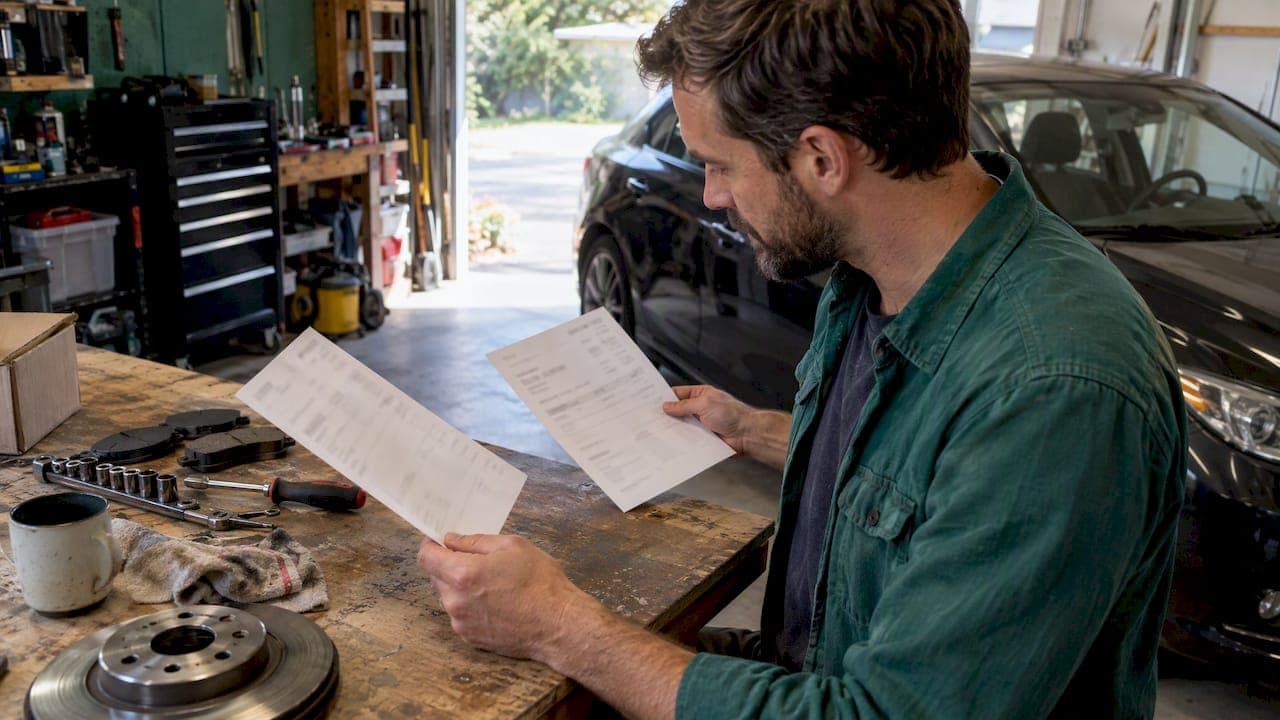
To estimate a car repair cost, get at least two itemised written quotes, then price the same job as a DIY build: parts, tools, consumables and your time. Put the two side by side. The gap tells you whether the workshop quote is fair and whether doing it yourself is worth it. This guide shows you how to do both, with Australian price benchmarks and the consumer rules that protect you.
TL;DR
- Ask for written, itemised quotes (work, parts, labour, completion time) from at least two repairers, and tell them to call you before any extra work.
- Services in Australia generally run $140 to $550, and repairs vary far more, so benchmark your job by make, model and state.
- For DIY, count everything: parts, tools you don't own, fluids, disposal and your time, not just the part price.
- Use the gap between the quote and your DIY total to decide. Safety-critical jobs need honest skill checks first.
Table of Contents
- Start with the fault, not the price
- Get a quote that you can actually compare
- What car repairs cost in Australia: realistic benchmarks
- Why the same repair costs different amounts
- How to build your own estimate, step by step
- DIY versus workshop: counting the whole cost
- Perspective: why we built a different way to estimate
- Plan the DIY side with DIYPro
- If the final bill is higher than the estimate
- Red flags and green flags in a quote
- FAQ
- Sources
Start with the fault, not the price
A price means nothing until the job is defined. "Brakes squeal" could be a $0 shim fix, a set of pads, or pads, rotors and a caliper. Before you ask anyone for a number, write down:
- The symptom (noise, warning light, leak, smell, when it happens).
- The vehicle: make, model, year, engine and transmission.
- What you have already checked or replaced.
- Whether the car is safe to drive in the meantime.
Then ask the repairer to explain the fault without jargon. Queensland's Office of Fair Trading recommends exactly that, along with getting at least two quotes. If a mechanic can't explain why a part needs replacing, that is information in itself.
Get a quote that you can actually compare
Verbal estimates are hard to hold anyone to. Written quotes are more specific and itemise parts and labour, which is why consumer regulators push them. Consumer Affairs Victoria says a written estimate should cover the work to be done, the parts to be supplied, estimated completion time, payment method, and estimated parts and labour costs.
What a good quote lists
| Line | What to look for |
|---|---|
| Work to be done | Specific actions, not just "fix brakes" |
| Parts | Brand or grade, and whether new, genuine, aftermarket or reconditioned |
| Labour | Hours estimated and the hourly rate, or a fixed price |
| Consumables | Fluids, gaskets, shop supplies, disposal fees |
| Timing | Estimated completion time |
| Payment | When and how you pay |
| Authorisation | A clear note that you will be called before any extra work |
That last line matters most when bills blow out. Make it clear you must be called before work begins on anything you haven't authorised. Queensland's guidance also says to check whether a written quote costs anything and to authorise all work, including additional work. Diagnostic time is often the one thing a workshop charges for, so ask upfront.
A signed job card is the other document to know about. Consumer Affairs Victoria notes it should specify the action to be taken, including the type of repairs required. Read it before you sign.
What car repairs cost in Australia: realistic benchmarks
There is no single average repair price, because "repair" covers everything from a wiper blade to an engine. These figures give you a frame of reference.
- Routine services: Canstar puts car services in Australia at $140 to $550, depending on make and model, the mechanic and the type of service.
- Average spend per visit: The Australian Automotive Aftermarket Association reports the average cost per consumer car service or repair was $250 in 2024, down from $280 in 2021. That is an average across many small jobs, so don't treat it as a quote for a brake or clutch job.
- Fleet vehicles: The same report gives an average of $800 per service or repair for fleet vehicles, reflecting higher kilometres and preventative work.
- Household running cost: The Australian Automobile Association's index found the national average weekly cost of servicing and tyres for a household was $35.15 in the March 2025 quarter.
- Big-ticket surprises: A CHOICE study of 14 contaminated fuel cases found an average repair cost of $4,986. It's an extreme case, but it shows how fast a fault can exceed a car's worth.
A major service can bundle in extra work such as wheel alignment, spark plug replacement, brake fluid checks and oil testing and replacement, so two services with the same name can carry very different prices. Compare what's included, not the headline figure.
Why the same repair costs different amounts
If your quote is far from a friend's, check these before assuming someone is overcharging.
- Make and model. Prices vary from brand to brand and workshop to workshop. European and performance cars typically carry dearer parts and more labour time.
- Where you live. Canstar notes that location affects service prices across states and territories. The AAA index found servicing and tyre costs can differ by up to $910 a year between Canberra and Adelaide.
- Part grade. Genuine, quality aftermarket and budget parts can sit at very different prices for the same job. We cover that trade-off in our guide to OEM vs aftermarket parts.
- What's excluded. Capped-price servicing sounds simple, but RAC WA warns you to read the fine print, since tyres, brakes and wipers are often excluded.
- Condition and history. Flood damage is the extreme case. RACQ explains that repairs can involve thousands of connectors and are often prohibitive, usually ending in a write-off. Starting a flooded engine can also bend conrods and valves through hydraulic lock, turning a bad bill into a worse one.
How to build your own estimate, step by step
- Name the job precisely. Use the symptom list above and confirm the diagnosis, ideally with a written quote that names the fault.
- Collect two or more written quotes. Ask each for the same itemised layout, and for the part brand or grade.
- Split each quote into parts and labour. Labour is where workshops differ most, and parts are where you can check prices yourself.
- Price the parts independently. Look up the same grade of part from a few suppliers, and note whether the quote has a markup.
- Add the tools and consumables. This is the step most DIYers skip (see below).
- Add a contingency. Seized bolts and broken clips happen. A sensible buffer on the parts total stops a cheap job becoming a stalled one.
- Compare. Workshop total minus your full DIY total is your real saving, before your time is valued.
DIY versus workshop: counting the whole cost
Workshop quotes bundle parts, labour, equipment, insurance and warranty. A DIY job has none of that built in, so you need to rebuild it yourself.
The DIY cost list
- Parts matched to your exact vehicle.
- Tools you don't own: a torque wrench, axle stands, a brake caliper tool, a scan tool. Spread the cost over future jobs, but count it honestly the first time.
- Fluids and consumables: oil, coolant, brake fluid, cleaner, gloves, rags. Getting the right fluid matters. Our explainer on coolant types shows why the wrong one can cost you more than you saved.
- Disposal: used oil and old parts need proper disposal.
- Your time: a first-timer takes longer than a flat-rate labour guide suggests.
Where DIY pays off, and where it doesn't
DIY tends to save the most on jobs where labour is most of the quote and the work is straightforward: filters, batteries, wipers, globes, and brake pads for those who are confident. For brakes, product choice also matters, so see our comparisons of ceramic vs semi-metallic pads and slotted vs drilled rotors.
It pays off least where a mistake is dangerous or expensive: airbags, major brake hydraulics if you haven't done them before, and anything that needs specialist diagnostic gear. A workshop's warranty is part of what you pay for. Be honest about your skill level before you commit.
A worked example
In the example we use at DIYPro, a typical workshop quote of $1,701 for a job compares with a full DIY parts-and-tools build that leaves you about $949 better off. That means a DIY outlay of roughly $752, covering every part, tool and product on the list. Your numbers will differ with your car and the tier of parts you pick, which is exactly why a line-by-line comparison beats a rule of thumb.

Perspective: why we built a different way to estimate
We see the same three problems again and again. Parts prices are scattered across a dozen tabs. Tutorials assume you already own the right tools. And nobody can tell you whether a $1,700 quote is fair or a rip-off without spending a weekend on research.

So we start with one question: what's wrong with your car, or what do you want to do to it? From there you should see the whole picture, every part, tool and product, set against what a mechanic would charge. Then you pick a tier: premium, value or budget. A budget brake pad on a daily commuter is a different decision from a premium pad on a car you tow with.
Our view is that DIY isn't about proving something. Sometimes the right answer is to hand the keys over, and a clear cost comparison should make that easy to say too. What we want is for you to make the call with real numbers rather than a gut feeling or a vague fear of being ripped off.
— Ryan
Plan the DIY side with DIYPro
DIYPro is built for Australian car owners who want that comparison in one place: the full DIY cost with matched parts, tools and skill-level tutorials, set against workshop pricing, with line-item breakdowns for jobs like oil changes, batteries, brakes and filters. We're currently building the platform and collecting early users.
If you're tired of juggling tabs, join the DIYPro waitlist and we'll let you know when your jobs are ready to compare.
If the final bill is higher than the estimate
This is where your paperwork earns its keep.
- Check what you authorised. Compare the invoice with your written quote and job card. Anything not authorised should have triggered a call to you.
- Ask for an itemised account before paying. Consumer Affairs Victoria says to obtain an itemised account listing the work undertaken and how costs were calculated.
- Query differences in writing. Name the line, the quoted figure and the charged figure, and ask for an explanation.
- Contact your state or territory fair trading or consumer affairs office if you can't resolve it. They publish current steps for your state.
After a big unexpected cost, a second opinion from another recognised mechanic is standard. CHOICE makes the same point when repair bills are high: get a proper estimate from a recognised mechanic.
Red flags and green flags in a quote
Red flags
- A single line total with no parts or labour split.
- Pressure to approve immediately for a non-urgent fault.
- No explanation of why a part needs replacing.
- Refusal to put anything in writing.
- Vague wording that lets extra work slip in without a call.
Green flags
- Itemised parts with grade or brand.
- Labour shown as hours and rate, or a clear fixed price.
- Willingness to show you the worn part.
- A clear promise to call before any added work.
- A plain-language explanation of the fault.
FAQ
How much does it cost to service a car in Australia?
Canstar puts typical car services at $140 to $550. Where you land depends on your car's make and model, the workshop and the type of service. Major services cost more because they include extra checks and replacements.
How accurate is a car repair estimate?
A written, itemised quote is more reliable than a verbal one because it sets out the work, parts and labour. It's still an estimate, so extra faults found mid-job can change it. That's why you should insist on being called before any unauthorised work begins.
Is it cheaper to repair a car myself?
Often, on simple jobs, because labour is usually the biggest part of a workshop quote. But you must add tools, fluids, disposal and your time, and be realistic about safety. Price both routes line by line before deciding.
Should I get more than one quote?
Yes. Queensland's fair trading guidance recommends at least two written quotes. Ask each repairer to quote the same job in the same itemised format so you can compare like with like.
Sources
- Get your car repaired, Queensland Government
- Car services and repairs, Consumer Affairs Victoria
- Car servicing cost, Canstar
- Strong growth ahead for aftermarket industry, AAAA
- Transport Affordability Index, March quarter 2025, AAA
- Common car servicing questions, RAC WA
- What to do if your vehicle has been flooded, RACQ
- Petrol stations sell dirty fuel, CHOICE