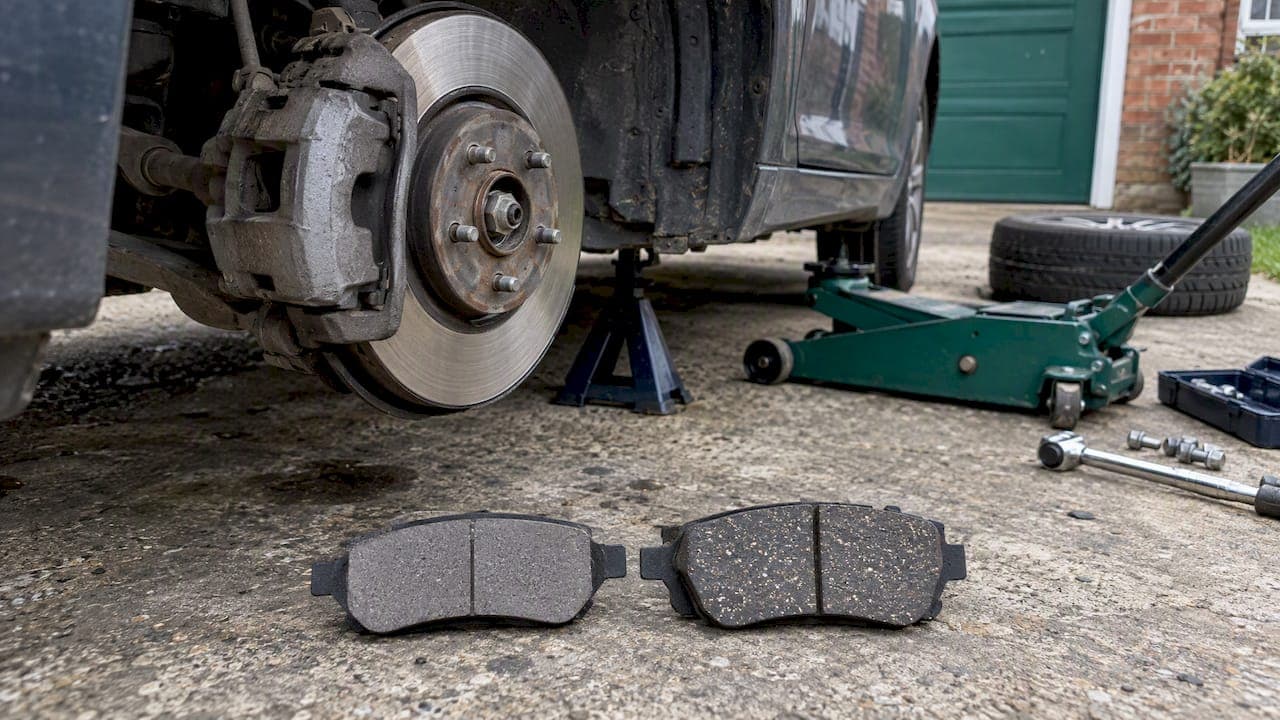
For most Australian cars used for commuting, school runs and highway trips, ceramic pads are the better pick: they are quiet, make little dust and last well. Semi-metallic pads (the pads people usually mean by "metallic") win when brakes get properly hot, such as towing, heavy 4WDs, mountain descents and spirited driving. Organic pads sit below both for durability. The rest of this guide shows how to choose for your car and how to price the job before you buy.
TL;DR
- Ceramic: best for daily city and highway driving. Quietest, cleanest, long-lasting, but dearer and less happy under extreme heat.
- Semi-metallic: best for towing, heavy vehicles and performance use. Strong bite and heat handling, but noisier, dustier and harder on rotors.
- Organic: soft, quiet and cheap, suited to light use, but they wear faster.
- Never mix compounds on one axle, and check what your manufacturer recommends before you buy.
- Pads alone usually run about $80 to $150 per axle, so doing it yourself saves most of the workshop bill.
Table of Contents
- What the three pad types are made of
- Ceramic vs semi-metallic at a glance
- Noise and dust
- Heat, fade and towing
- Rotor wear and compatibility
- Which lasts longer?
- Ceramic vs organic
- The real downsides of ceramic pads
- How to choose: a short decision guide
- What it costs in Australia
- Our view: match the pad to the job, not the hype
- Plan the job before you buy
- FAQ
- Sources
What the three pad types are made of
A brake pad is a steel backing plate with a block of friction material bonded to it. What goes into that block decides almost everything you notice: noise, dust, bite, wear and how it behaves when hot.
Ceramic pads use a dense ceramic compound mixed with copper fibres. Superspares describes them as quiet, low in dust and long-lasting, suited to everyday city and highway driving.
Semi-metallic pads blend metal fibres or particles, such as steel, copper or iron, with graphite and friction resins, according to Universal Auto Spares. The metal makes them tough and good at carrying heat away from the rotor.

Organic pads are made from non-metallic materials such as rubber, glass fibre, carbon and resins bonded together, as the same guide explains. They are soft and gentle, which is why they are quiet and kind to rotors, and also why they wear out sooner.
One caveat on the word "metallic". Some searches lump semi-metallic, fully sintered metallic and carbon-metallic pads together. Sintered metallic pads are mostly found on bikes and motorsport. Carbon-metallic pads, for example, create a transfer layer on the rotor that grips harder as it heats up, which is why they appear in big brake kits. For a normal road car, the real choice is ceramic or semi-metallic.
It is also worth knowing that recipes vary a lot. Manufacturers draw on roughly 400 different compounds and substances, so two pads sold under the same label can feel different. The category tells you the tendency, not the whole story.
Ceramic vs semi-metallic at a glance
| Factor | Ceramic | Semi-metallic | Organic |
|---|---|---|---|
| Noise | Among the quietest | Can be noisier | Quiet |
| Dust | Minimal | More dust | Low to moderate |
| High-heat performance | Less effective under extreme heat | Best, resists fade | Poor for heavy use |
| Rotor wear | Gentle | More abrasive | Gentle |
| Life in everyday driving | Long | Shorter | Shortest |
| Typical use | Commuting, highway | Towing, heavy 4WDs, performance | Light, low-load driving |
| Price | Higher | Mid | Lowest |
The qualitative rankings above come from Australian parts guides: Repco says semi-metallics usually give the best performance across a range of temperatures, conduct heat well and resist fade, while ceramics are among the quietest and make less dust. Treat the table as a tendency, not a guarantee for every brand.
Noise and dust
If you hate scrubbing grey-brown dust off alloy wheels, ceramic is the pad for you. Ceramic compounds produce little dust, and what they do make is lighter in colour and tends to wash off easier. Semi-metallic pads shed more dark dust, and they can be noisier, especially when cold or in light braking.
Noise is as much about fitment as material. A squeal after a pad change is often a missed step: no brake grease on the contact points, glazed rotors, or worn hardware. If you are doing the job yourself, fresh clips and shims matter as much as the pad you choose.
Heat, fade and towing
Heat is where the two really separate. Brakes turn movement into heat, and when pads get too hot they lose grip. That is brake fade.
Semi-metallic pads handle this best, because the metal conducts heat away and holds friction across a wide temperature range. That is why they suit:
- towing a caravan or boat
- heavy utes, vans and loaded 4WDs
- long descents, like the Great Dividing Range or Tasmanian passes
- track days and enthusiastic driving
Ceramics prefer moderate temperatures. Mechanic.com.au notes that ceramic pads need a higher optimal operating temperature than organic and semi-metallic pads, so they are not interchangeable with other types. The practical lesson: do not put a ceramic pad on one side of an axle and something else on the other, and do not mix compounds front to rear without a reason.
If you are towing regularly, ceramic is not automatically wrong, but it is where the compromise shows. Check what your manufacturer specifies for towing vehicles and match the pad to the heaviest thing you do, not the average trip.
Rotor wear and compatibility
Semi-metallic pads are harder and more abrasive, so they wear rotors faster. Ceramics are gentler on rotors, which can stretch the life of a set of discs. That matters because rotors cost far more than pads.
Two cautions:
- Do not switch to a more aggressive pad on tired rotors. Measure rotor thickness against the minimum stamped on the disc, and replace worn or heavily grooved rotors.
- Pair pads and rotors sensibly. Performance rotors are often designed with a particular pad type in mind. If you are weighing upgrades, our guide to slotted vs drilled rotors covers when they are worth the money and when they are not.
Which lasts longer?
In everyday driving, ceramic generally lasts longer than semi-metallic, which wears faster under heavy loads, according to Superspares. That same guide puts the average across all pad types at around 40,000 to 60,000 km, while Tyrepower gives a wider range of 40,000 to 100,000 km and stresses it is not a fixed rule.
What moves you within that range:
- Traffic: stop-start city driving wears pads faster than open rural or highway driving.
- Weight and towing: heavier vehicles load the brakes harder.
- Driving style: late, hard braking eats pads.
- Axle: front pads wear faster than rear because they do most of the braking.
So a Sydney commuter in a hatchback and a Queensland farmer towing a trailer could fit the same pad and get very different life from it. Choose for the use, not the claimed kilometres. As one Australian workshop puts it, the best pad is the one that matches the vehicle and how it is used.
Ceramic vs organic
Organic pads are the budget end. They are quiet and soft on rotors, and they suit light everyday driving, but they wear faster and are not ideal for heavy-duty use. Ceramic is quiet too, and adds long life and low dust.
Pick organic only if the car is light, lightly used and your manufacturer allows it. For most drivers, the extra spend on ceramic is repaid in fewer pad changes. If you drive hard or heavy, skip organic altogether.
The real downsides of ceramic pads
People ask this one a lot, so here it is straight:
- Cost. Ceramic pads cost more than organic and often more than semi-metallic.
- Heat limits. They are less effective under extreme heat, so they are not the first choice for towing, track use or heavy loads.
- Less initial bite. Many drivers find the pedal feel softer than a semi-metallic pad when cold.
Semi-metallic downsides mirror those: more noise, more dust, more rotor wear. Neither type is bad. They are tools for different jobs.
How to choose: a short decision guide
Work through these in order.
- Check what the manufacturer recommends. Your owner's manual or the original pad type is your starting point. Ignoring it is how people end up with poor braking or constant squeal.
- Be honest about your heaviest use. Towing, steep descents or track days point to semi-metallic. Daily commuting points to ceramic.
- Look at your rotors. Worn rotors need replacing whichever pad you choose, and abrasive pads on thin discs are false economy.
- Set a budget tier. A reputable value pad of the right compound beats a premium pad of the wrong one.
- Buy matched parts. Pads, clips, hardware and brake grease should suit your exact model.
A note on parts quality: genuine versus aftermarket is its own decision, and our piece on OEM vs aftermarket parts walks through it for Australian buyers. And if you import pads from overseas, be careful. Australia used asbestos in brake friction material before the mid-1990s, and the national asbestos safety agency warns that sourcing aftermarket brakes from suppliers in countries that still allow it is a risk. Buy from established Australian suppliers.
What it costs in Australia
Pads alone typically cost about $80 to $150 per axle, depending on material, brand and vehicle. A supplied-and-fitted job is a different number. One Australian parts supplier estimates roughly $150 to $400 per axle for pads supplied and fitted, and more when rotors are involved, with larger SUVs, 4WDs and performance cars at the top end.
When you are checking a workshop quote, ask for it split into lines:
- pads (brand and compound)
- rotors, resurfaced or replaced
- hardware, clips and grease
- brake fluid, if included
- labour hours and rate
If a quote bundles everything into one figure, you cannot tell whether you are paying for ceramic pads and new rotors or budget pads and a skim. The gap between parts and fitted price is where DIY saves money.
A legal note: in NSW, fitting replacement service-type parts such as brake pads may not need certification when you use manufacturer-supplied or equivalent aftermarket parts. Rules differ by state, so check yours with your state transport authority before fitting anything non-standard.
Our view: match the pad to the job, not the hype
We come at this from the workshop floor. Our founder has more than 25 years as a mechanic, and the same pattern turns up again and again: people agonise over ceramic vs semi-metallic and then skip the steps that actually decide how the brakes feel. Rotor condition, clean slide pins, fresh grease on the right spots and a proper bed-in matter just as much as the compound.
Our honest default is simple. If the car lives in traffic and on highways, fit quality ceramics. If it tows, carries load or gets driven hard, fit quality semi-metallics and accept a bit more dust. Organic is fine for a light runabout if that is what the car came with. Beyond that, a mid-priced pad of the right type from a reputable brand will serve you better than the dearest box on the shelf.
Brakes are also a safety system, so be realistic. If you are a beginner, brake pads are a reasonable first job with the right tutorial and tools. But if you feel a spongy pedal, see fluid leaks, or the car pulls under braking, have a qualified mechanic look at it rather than working it out in the driveway.
— Ryan
Plan the job before you buy
The hardest part of a brake job is usually not the spanners. It is working out which pad, which tools and whether the quote you have been given is fair. DIYPro starts with one question, what do you want to do to your car, then shows the full DIY cost against a typical workshop quote, with every part, tool and product listed. You choose a premium, value or budget tier and get tutorials matched to your skill level. Join the DIYPro waitlist to be first in when it opens.
FAQ
Are ceramic or semi-metallic pads better?
Neither wins everywhere. Ceramic is better for quiet, clean, everyday driving, and semi-metallic is better for towing, heavy vehicles and performance use. Start with what your manufacturer recommends, then match the pad to your toughest regular use.
Can I mix ceramic and semi-metallic pads on the same car?
Not on the same axle, and ideally not at all. Pad types work best at different temperatures, so mixing can give uneven braking. Fit the same compound on both wheels of an axle, and replace pads in axle sets.
Which brake pads last longer?
In normal driving, ceramic pads generally last longer than semi-metallic. Real life depends on traffic, vehicle weight, towing and how you brake, and front pads wear out before rears. Averages quoted by Australian suppliers span about 40,000 to 100,000 km.
What is the downside of ceramic brake pads?
They cost more and are less effective under extreme heat, which makes them a weaker choice for heavy towing or track use. Some drivers also find they have less initial bite than semi-metallic pads.
How do I know which pads are on my car now?
Colour is not a reliable guide. Check the pad's box or part number against the supplier's listing, or ask the shop that last serviced the car. If you cannot confirm it, choose the pad type your manufacturer recommends for your model.
Sources
- Brake Pads Buying Guide, Superspares
- Brake Pad Replacement Costs Explained, Superspares
- Brake Pad Types Explained, Universal Auto Spares
- Pros and Cons of Different Brake Pads, Repco
- What are Brake Pads, and How do they Work?, Mechanic.com.au
- Brake Replacement Cost Guide 2026, AME Motorsport
- The Actual Cost of Replacing Brake Pads in Brisbane
- How Long Do Brake Pads Last?, Tyrepower
- Ceramic vs Semi Metallic Brake Pads, Albury Brake & Clutch Centre
- Automotive brake shoes and linings, Asbestos Safety
- Modified and non-standard vehicles, NSW Government